A wet product sticks. It adheres to auger flights, it agglomerates in the impeller, it blocks filling spouts. A non-homogeneous product — a mix of different granule sizes, crystallised material, raw salt from a saltworks — segregates and corrupts volumetric metering.
The KSM-BD40 belt bagging machine takes a different approach: instead of pushing or projecting the product, it extracts it with a belt running under the hopper. Product simply falls onto the belt and is carried to the filling spout. Nothing can clog, because there is no rotating element inside the material.
Metering is by net weighing with two belt speeds: bulk rate for most of the charge, dribble rate for finishing. Accuracy reaches ±0.2 %, and throughput goes up to 40 tonnes per hour — by far the highest capacity machine in our range.
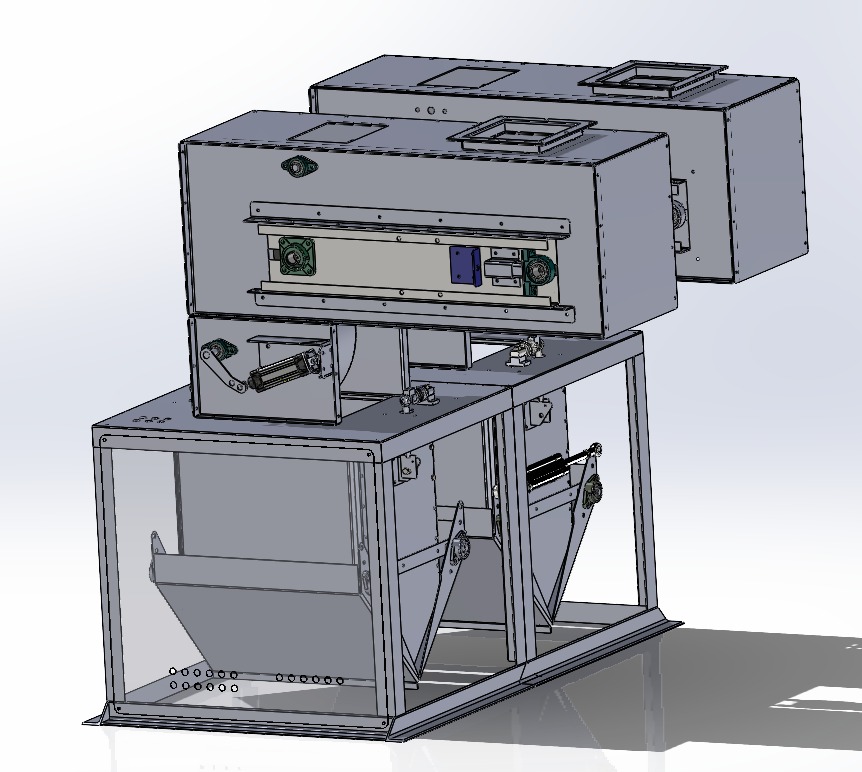
Two-station structural design
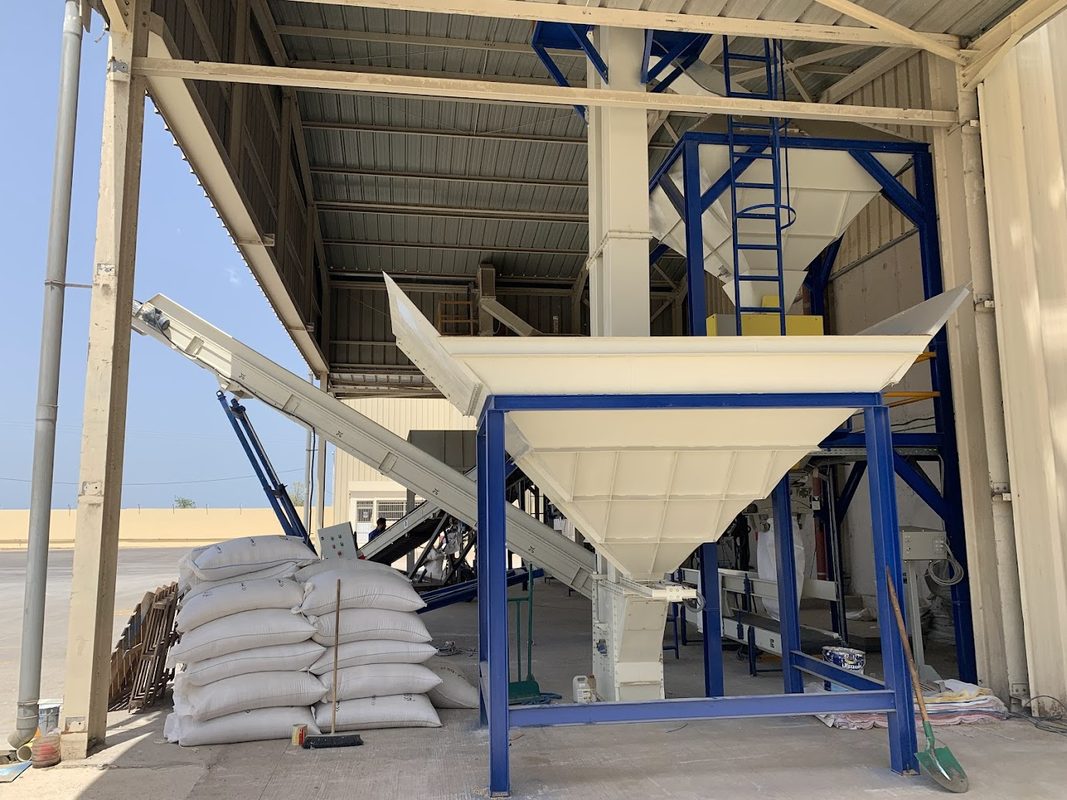
The KSM-BD40 is supplied on a complete steel structure with access walkway and safety guardrails. The structure carries the surge hopper, the two net weighers and the filling spouts.
This two-station layout allows continuous alternating operation: while the first station discharges a filled bag, the second is already weighing the next charge. That is what sustains a real 40 t/h throughput with no dead time.
Walkway access makes maintenance and cleaning straightforward: on wet products, being able to clean the hopper and belt easily at the end of a campaign is a selection criterion that is often underestimated.
Open-mouth bags and big bags on the same machine
The KSM-BD40 filling spouts accept both open-mouth bags of 25 to 50 kg and big bags of 500 to 1,500 kg. This matters for fertiliser and salt producers, who supply bags to the retail market and big bags to large agricultural or industrial customers.
Switching modes is done by selection on the HMI, with no heavy mechanical change. The big-bag lifting frame and hooking system are built into the structure.
Siemens control and traceability
The machine is controlled by a Siemens S7-1200 PLC with touchscreen HMI. The PLC manages bulk/dribble changeover set points, in-flight compensation, hopper level alarms and production counting.
Every weighment is recorded: bag count, individual weights, batch total, deviations. The data is exportable and, as an option, transmitted to our cloud supervision platform for production monitoring from any connected device.