The valve bag has one decisive advantage: it closes by itself. No sewing, no heat sealing, no operator station downstream. But it imposes a technical constraint — product must be forced through an opening a few centimetres wide, against the air already inside the bag.
The KSMV / KSMSV125 packer answers this with a 7.5 kW centrifugal impeller running at 1,500 rpm. The impeller accelerates the product and projects it through the valve at high speed while excess air escapes through the porous bag wall. The result is a dense, well-filled bag with no air pockets, at an output of 6 tonnes per hour.
As on all our machines, filling runs in two stages: full speed up to the approach set point, then automatic slowdown for finishing to ±100 g. Weight is measured by an HBM RSCM 100 kg load cell connected to an HBM WE 2107 indicator.
Fluidisation: the detail that prevents downtime
A fine powder left standing in a hopper compacts and forms a bridge. Production stops, an operator hammers the hopper wall, and the cycle repeats a few minutes later.
The KSMV includes a fluidisation system across 3 to 4 positions in the hopper base: low-pressure air is injected through porous membranes, keeping the product in a near-liquid state. Powder then flows steadily to the impeller whatever its fineness. On cement and hydrated lime, this is the difference between a machine that runs eight hours straight and a machine that has to be unblocked every hour.
Station composition
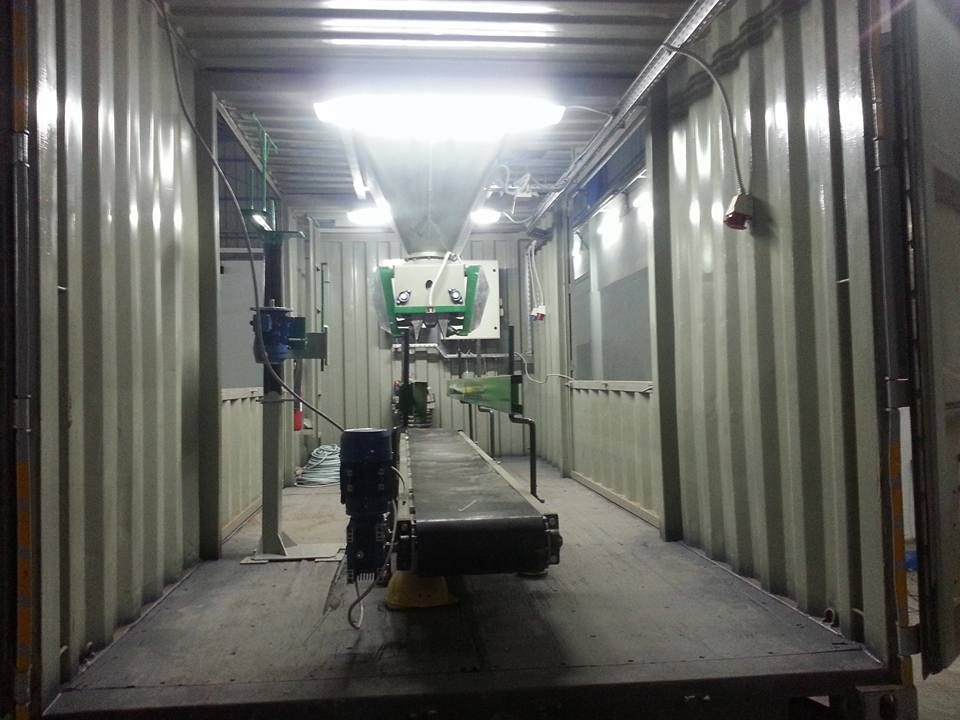
- Receiving hopper with multi-position fluidisation and isolation valve
- 7.5 kW centrifugal impeller with two speeds controlled by variable-frequency drive
- Valve filling spout with bag inflator and automatic ejection of the filled bag
- HBM RSCM 100 kg load cell and HBM WE 2107 indicator
- Discharge conveyor with 400 mm PVC belt, 2 m or 3 m length
- Complete control panel, wiring diagrams, manual and operator training
Valve bag or open-mouth bag: how to choose
The valve bag makes sense when the product is a fine powder and you want to remove the sewing station: cement, lime, plaster, dry mortars, carbonates. The bag seals under internal pressure, so the line is shorter and needs fewer people.
The open-mouth bag remains preferable for granular products, food products in kraft paper bags, and whenever the end user wants to empty the bag completely and easily. In that case look at the KSM-VB25 screw bagging machine or the KSM-GN50 mobile bagging station.
We build both technologies, and we will tell you honestly which suits your product — including whether a trial on a sample in our workshop is needed first.
Options and upgrades
Twin-spout version to double output; AISI 304 stainless for food duty; integrated dust collection with filter bags; downstream checkweigher with automatic rejection of out-of-tolerance bags; inkjet batch coding; cloud supervision for remote production monitoring.